When the Needle Disappears: SonoCoat® in Three Clinical Applications
New technology brochure
Bram Pape
September 14, 2026

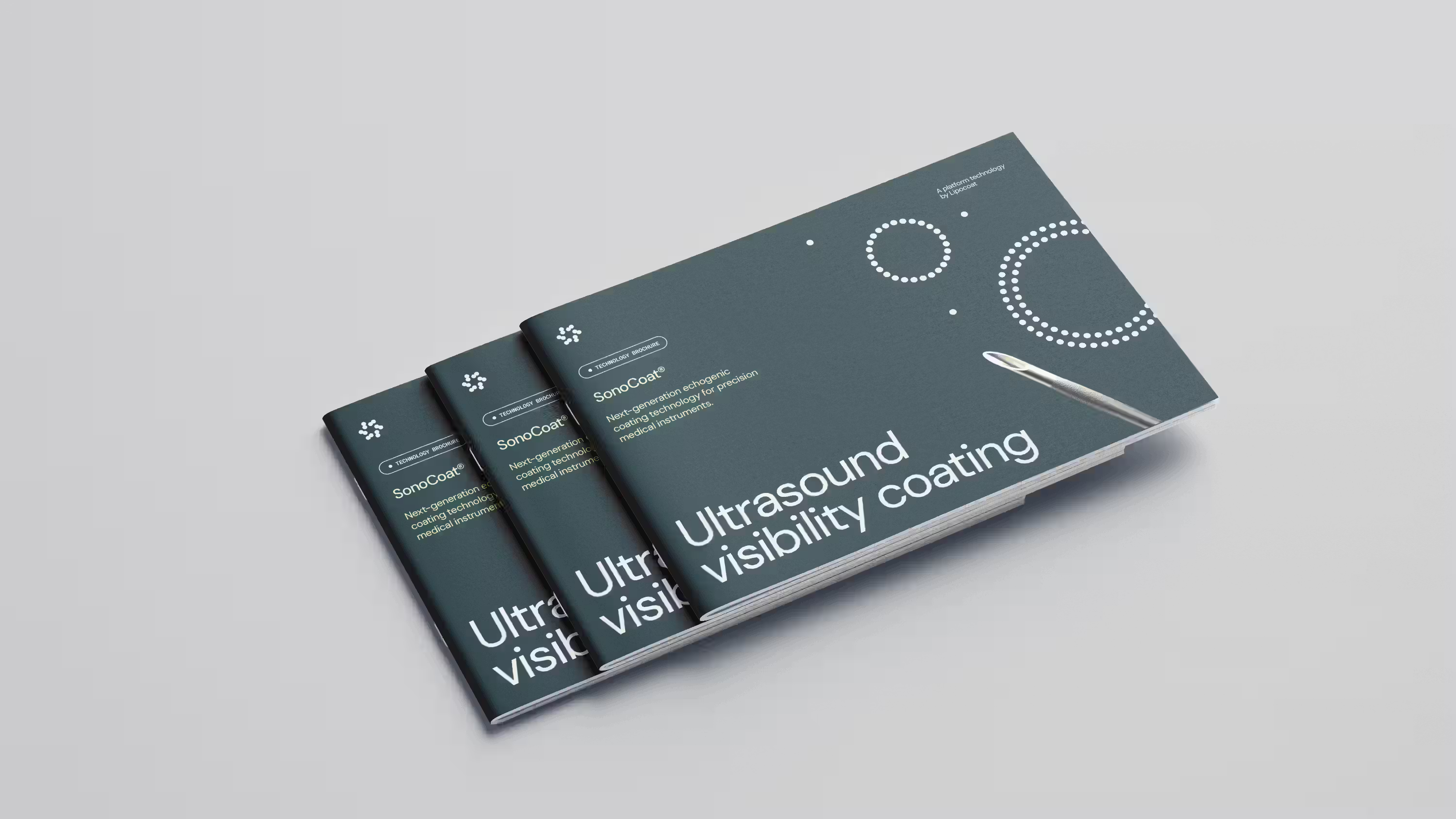
Ultrasound guidance has become the standard of care across an expanding list of procedures. Instrument visibility has not kept pace. Our new SonoCoat® technology brochure looks at where conventional echogenic needles fall short in daily clinical practice, and at the coating technology built to close that gap.
Virtually all international medical institutions now mandate or strongly advise real-time 2D ultrasound guidance during central venous catheter (CVC) insertions. The guidance requirement is settled. The visibility of the instrument is another matter. Deeper vessels demand steeper insertion angles, and at those angles a conventional needle fades from the display, leaving the clinician operating blindly at the moment precision matters most.
During tissue biopsies and tumor ablations, standard echogenic needles frequently blend into surrounding acoustic tissue noise, especially when the target is a small or deep lesion. That creates a risk of missing the target, which can lead to false-negative diagnoses or accidental damage to adjacent organ structures. SonoCoat® improves acoustic contrast and edge definition, so the tip stays clearly localized against the tissue around it.
Conventional needles lose acoustic reflection at insertion angles beyond 45 degrees. SonoCoat® embeds acoustically reflective microspheres in a biocompatible polymer matrix, scattering sound waves back toward the probe regardless of device orientation. Tracking stays uniform and high-contrast across steep angles and deep acoustic pathways, with no probe or trajectory adjustments required.
In an independent NICE study published in Gastrointestinal Endoscopy, SonoCoat® was evaluated against nine widely used EUS-FNA biopsy needles. Sixty experienced clinicians conducted blind assessments of the devices. The SonoCoat®-coated needle earned top overall ranking, scoring 10% to 40% higher in acoustic visibility than every competitor (p < 0.01).
SonoCoat® is an additive surface treatment applied to your finished device at an adjustable thickness of 25 to 90 µm, with M-series and P-series formulations for common medical metals and polymers. Device dimensions, flexibility and mechanical behavior stay exactly as designed. Clearer ultrasound visualization also decreases reliance on fluoroscopy, which protects healthcare staff from prolonged radiation exposure and heavy lead apparel.
The technology brochure goes further into the three integration options, the specifications, biocompatibility testing under ISO 10993-5 and ISO 10993-10, and the angle-dependent reflection data behind these claims.

LipoCoat and SonoCoat have earned recognition from leading institutions and regulatory bodies. Our coatings meet the highest standards for biocompatibility and clinical efficacy.

Four independent peer-reviewed studies have evaluated SonoCoat®, from EUS-FNA needles to prostate brachytherapy. What each one tested, and what it found.